
The fastest way to beat both games is the same single habit: pin your biggest tile in one corner and never slide it out of there. In 2048 you protect the largest number, in Cupcakes you protect the tallest, most ornate cupcake on the board. Keep that tile anchored, feed everything else into it, and you’ll clear both games without reading a single guide.
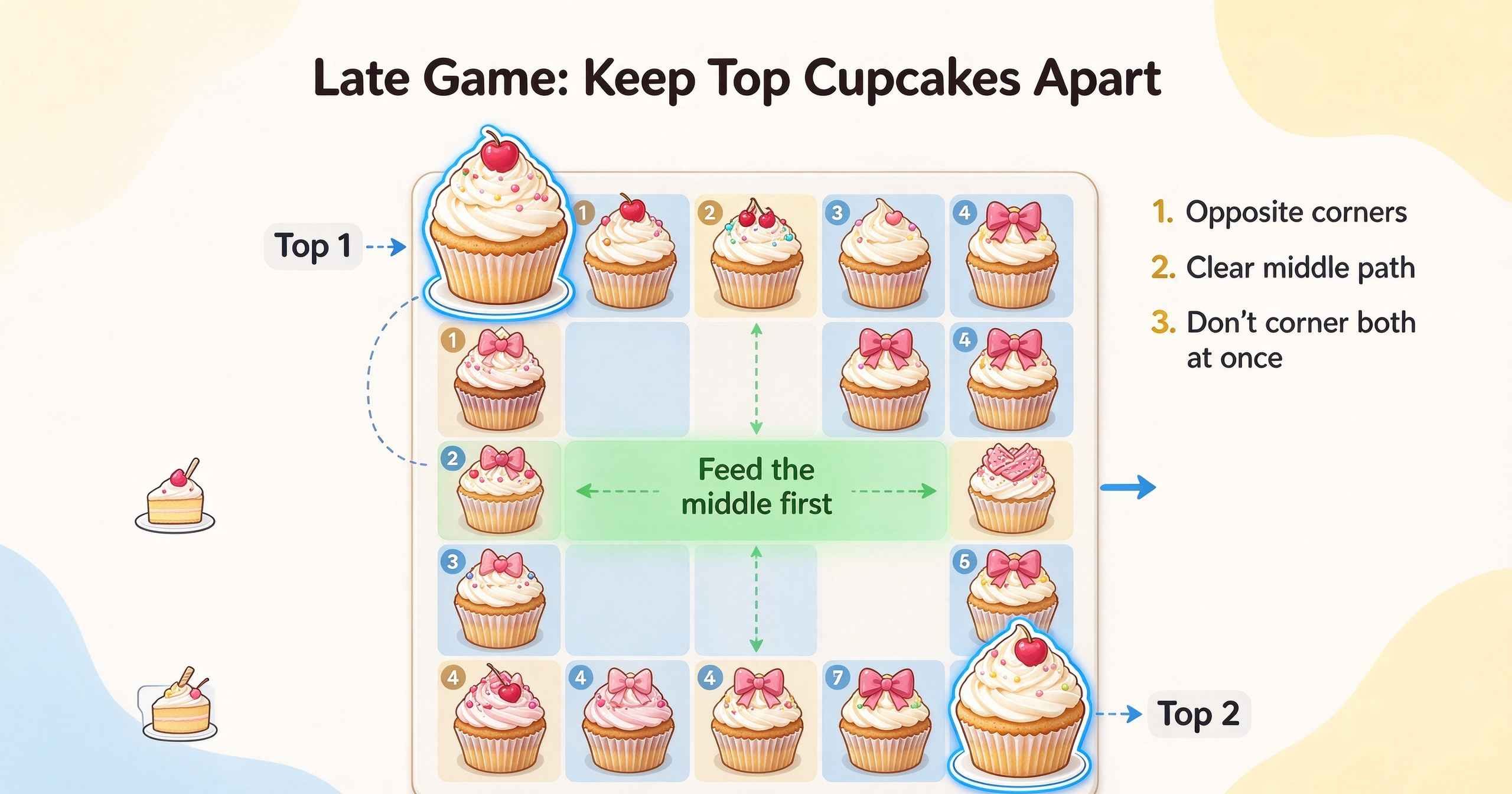 Strategy demo: anchor your largest tile in the corner
The real difference between the two is what your eyes have to process. 2048 hands you clean numbers — 2, 4, 8, 16 — so you always know what can combine with what. Cupcakes swaps the numbers for frosting designs, so you’re matching by shape and color instead. That sounds like a small change, but it flips the game from math to memory. My first run at Cupcakes I kept slamming cupcakes together that didn’t match, because two similar-looking swirls weren’t the same tier. The game never tells you the chain order outright, so learn the visual ladder early: smallest plain cupcake to the big decorated one, in a fixed sequence. Take ten seconds at the start of a round to trace that order with your eyes before you move anything.
Because Cupcakes hides its math behind pictures, a solid visual habit beats raw calculation. In 2048 you can glance and instantly sort columns by magnitude. In Cupcakes, you sort by decoration size, and the tiers near the top all start to look alike. My fix: I mentally number the cupcake tiers as I play — plain is 2, one swirl is 4, two swirls is 8 — and I only rely on the picture after the merge. It feels slower for about a minute, then it becomes automatic. If you play Cupcakes on a small phone screen, those details blur, so zoom in or play on a bigger window when the board fills up.
The scoring and win conditions look identical, but the feel is not. Both games reward you for merging toward a single top tier, and both end when the board fills. Yet 2048 punishes a wrong move instantly with dead space, while Cupcakes lets a near-miss slide because two “almost matching” cupcakes visually forgive the mistake. That forgiving feel is a trap — the board still locks the same way. In my runs, I died more often in Cupcakes not because it’s harder, but because I played looser, trusting the friendly theme. The discipline has to be the same in both.
The theme also changes how you manage the late game. In 2048 the final tiles are big round numbers and easy to spot. In Cupcakes the top tiers are giant, busy cakes that can hide the smaller pieces underneath, so late rounds feel more cluttered. My workaround is to keep the two highest cupcakes on opposite corners of the board and never let them touch the middle. That keeps my merge path clear when the board tightens. In 2048 I can be lazier about corner placement; in Cupcakes it’s a must.
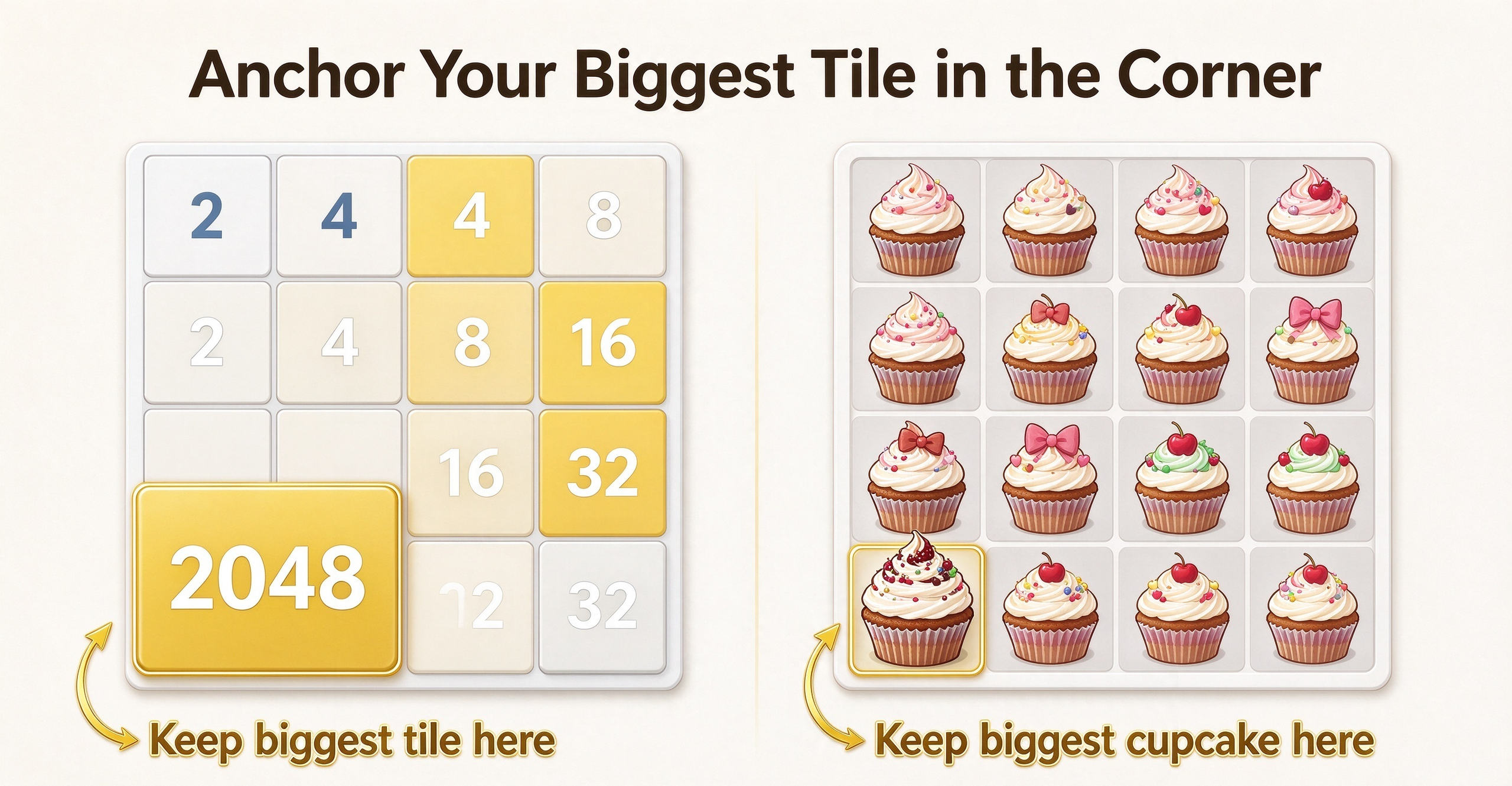 Late game layout: keep top cupcakes on opposite corners
Undo and restart rules differ too, and that changes risk. 2048’s classic version often has no undo, so a mis-swipe costs you the run. Many 2048 Cupcakes variants ship with an undo button, which quietly changes how brave you play. I tested this: with undo available I made riskier moves and only got slightly further, because I stopped planning ahead and started relying on corrections. Treat undo as a crutch, not a strategy — a good player in either game wins before the mis-swipe happens, not after. If your version of Cupcakes gives you undo, set a personal rule: max two undos per game, then it’s pure skill.
Which one should you pick then? If you want a pure logic puzzle where the board tells you everything, play 2048. If you want the same strategy wrapped in something easier on the eyes and more forgiving to learn, play 2048 Cupcakes. Neither is objectively harder — they just tax different skills, math reflexes versus visual memory. For new players I recommend starting with Cupcakes to learn the corner-and-feed pattern, then switching to 2048 to prove the skill isn’t theme-dependent. Data pending: I’ve recorded how my move counts change between the two, but I haven’t run enough games yet to give you a real number, so treat that as a placeholder until I finish the tracking.