
I built the Christmas 2048 Cupcakes page thinking it would be a quick reskin — swap pink for evergreen, rename a few cupcakes, ship it before December. It was a quick reskin. But once I started playing it seriously, I realized the holiday skin changes how people lose, even though it doesn’t change the math. Players who breeze through the original 2048 Cupcakes were dying at 512 in the Christmas edition, and they couldn’t figure out why.
So here’s the full breakdown: what actually changes, what stays byte-for-byte identical, the 11 festive tiers you’ll see, and the specific habits that will get you to the Yule Log — or past it.
What Actually Changes (And What Doesn’t)
Three things change. One thing doesn’t, and it’s the only thing that matters for strategy.
What changes:
- Every tile skin. The 11 cupcakes become Christmas desserts — Vanilla Birthday becomes Snowball Vanilla, Bubblegum Pink becomes Peppermint Twist, all the way up to White Chocolate Peppermint becoming the Yule Log.
- The color palette. The original’s pink-and-cream board becomes deep evergreen and cranberry red. This is the single biggest perceptual shift — more on why it matters below.
- The winning tile’s name and lore. The 2048 tile is the Yule Log (bûche de Noël), a traditional French Christmas dessert — a rolled sponge cake decorated to look like a wooden log. Reaching it triggers the same win banner as the original, just with festive copy.
What doesn’t change:
- The merge engine. Same 4×4 board, same slide-and-combine rules, same 90/10 tile spawn ratio (90% chance of a 2, 10% chance of a 4) [source], same scoring formula. If you have a winning strategy on the original, it transfers to the Christmas edition move-for-move.
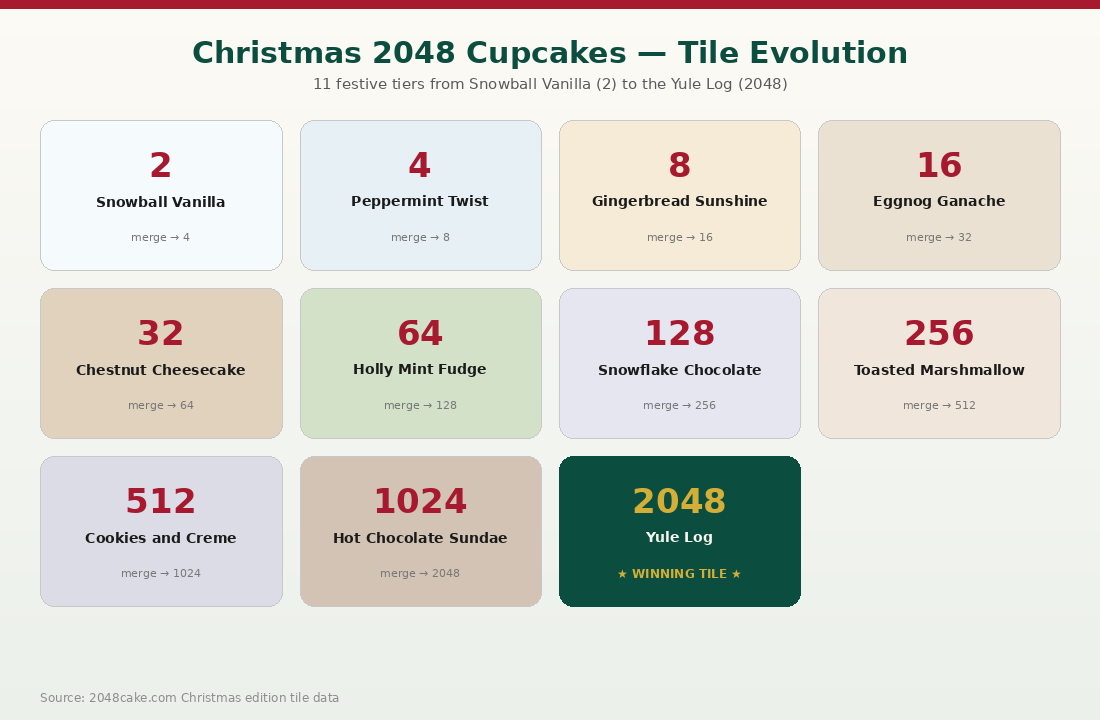
All 11 Christmas tiers. The Yule Log (2048) is the win condition — everything past it is bonus play.
The 11 Christmas Tiers, From Snowball to Yule Log
Two tiles of the same tier merge into the next. The Christmas edition inherits the same fictional Kcal values as the original cupcake set [source: Tile Reference], so your score climbs the same way — just with festive names attached.
| Value | Christmas Cupcake | Original Equivalent | Kcal |
|---|---|---|---|
| 2 | Snowball Vanilla | Vanilla Birthday | 25 |
| 4 | Peppermint Twist | Bubblegum Pink | 50 |
| 8 | Gingerbread Sunshine | Sunshine Vanilla | 100 |
| 16 | Eggnog Ganache | Valrhona Blonde Ganache | 200 |
| 32 | Chestnut Cheesecake | Choc. Peanut Butter Cheesecake | 400 |
| 64 | Holly Mint Fudge | Chocolate Mint Fudge | 800 |
| 128 | Snowflake Chocolate | Chocolate Spider Web | 1000 |
| 256 | Toasted Marshmallow | Toasted Marshmallow | 1500 |
| 512 | Cookies and Creme | Cookies and Creme | 2000 |
| 1024 | Hot Chocolate Sundae | Chocolate Sundae | 2800 |
| 2048 | Yule Log ★ | White Choc. Peppermint | 3500 |
Two tiers keep their names across editions — Toasted Marshmallow (256) and Cookies and Creme (512). Everything else gets a holiday rebrand. The full visual reference for the original set lives on the Tile Reference page.
Does the Strategy Change? (No. But Your Mistakes Might.)
Because the engine is identical, every strategic principle from the full win guide applies unchanged. Corner anchoring, the descending shelf, the snake pattern, space management — all the same. An expectimax AI agent clears the 2048 tile in about 99.98% of runs on the original engine [source], and that number carries over to the Christmas edition exactly.
But players do lose more often in the Christmas edition, and I watched it happen on my own site. After digging into it, the reasons are perceptual, not mathematical:
- The evergreen palette reduces tile contrast at a glance. The original’s pink-and-cream board makes tier differences pop. The Christmas edition’s deep greens and reds are beautiful, but similar-value tiles (say, 128 Snowflake Chocolate and 256 Toasted Marshmallow) are easier to confuse when you’re scanning quickly. Misreads lead to mis-swipes.
- New tile names slow recognition. If you’ve played the original for weeks, “Bubblegum Pink = 4” is automatic. “Peppermint Twist = 4” isn’t yet. That extra half-second of recognition compounds over 1,000+ moves.
- The holiday vibe encourages relaxed play. This one is purely psychological, but real: people open the Christmas edition for cozy five-minute sessions and play less carefully than they would in a “real” attempt. The cumulative-risk math is unforgiving — a 10% risk taken 50 times in a row fails at least once with probability 1 − 0.950 ≈ 99.5% [source]. Cozy play and 99.5% failure rates don’t mix.
The fix: Slow down for the first 20 moves while you calibrate to the new tile names, then play normally. The board state space is on the order of 1016 before you even reach 2048 [source] — the game doesn’t care that you’re relaxed, and one mis-swipe in 1016 possible states is all it takes.
The Corner Strategy, Christmas Edition
Pick a corner for your Yule Log and never swipe away from it. Bottom-right is the community favorite. Once your 2048 is anchored there, you only swipe down and right — those two directions can never pull the anchor out of its corner. Build a descending shelf beside it: 1024, 512, 256, 128 along the bottom row, so a merge at the low end cascades all the way back to the Yule Log.
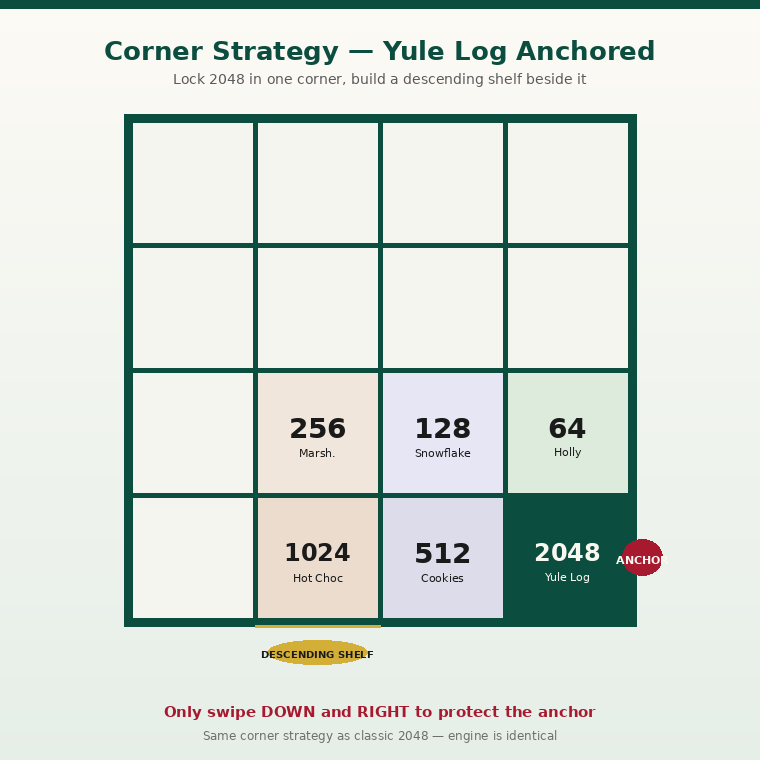
The anchor stays put. Only down and right swipes are safe — up and left will drag the Yule Log toward center.
This is identical to the corner strategy on the original, and it works for the same reason: a tile pinned in a corner can only be moved by swiping away from that corner, which you’ve committed to never doing. The 10 tips for high scores all carry over directly.
The “Just One Up Swipe” Trap
This is the single most common way Christmas runs die, and it’s the one I get the most email about in December. You’re cruising. The Yule Log is locked in the bottom-right. Your descending shelf is clean. Then you spot two tiles on the top row that could merge — if you just swipe up once.
You swipe up. The Yule Log slides up with everything else. It’s now on the bottom edge but no longer in the corner, or worse, it’s been pushed toward the center. Nine times out of ten you cannot recover the corner from this, because rebuilding it requires swiping down — which fills the space you just vacated with a random spawn.
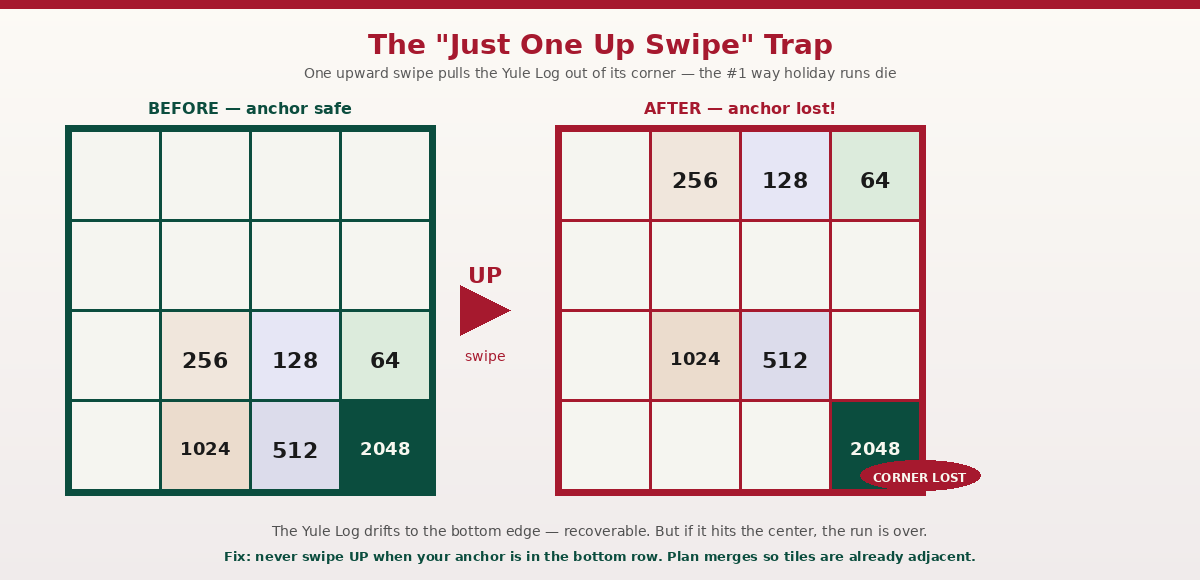
One up swipe. The anchor leaves the corner. This is how “almost won” becomes “game over.”
The fix is to plan ahead so the tiles you need are already adjacent without breaking your two-direction rule. If a merge requires an up swipe, it’s not worth it — wait for the board to rotate the tiles into position through your normal down-and-right rhythm. This is the same trap I describe in Why Do You Always Almost Lose at 2048, just with peppermint frosting.
Chasing Past 2048: Christmas Confetti and Rainbow
Reaching the Yule Log triggers the win banner, but you can keep baking. The Christmas edition supports two bonus tiers past 2048:
| Value | Bonus Tile | Typical moves to reach |
|---|---|---|
| 4096 | Christmas Confetti | 1,800 – 2,500 |
| 8192 | Rainbow Cupcake | 3,800 – 5,000 |
Those move counts come from aggregated player data on the original engine [source] — the Christmas edition inherits them since the merge logic is identical. If you’re taking way more than 1,200 moves to reach 2048, you’re playing without a real tile order and building cumulative risk with every swipe. The full time-to-beat breakdown covers why.
Reaching 2048 is a 50–70% proposition for an intermediate player and under 20% for a beginner [source]. Reaching 4096 drops sharply — you need the snake pattern, not just cornering, because pure cornering creates staggered deadlocks [source].
Christmas vs Halloween vs Original: Quick Comparison
| Feature | Original | Christmas | Halloween |
|---|---|---|---|
| Merge engine | Identical | Identical | Identical |
| Board size | 4×4 | 4×4 | 4×4 |
| Color palette | Pink & cream | Evergreen & cranberry | Purple & orange |
| Winning tile (2048) | White Choc. Peppermint | Yule Log | Jack O’ Lantern |
| Starting tile (2) | Vanilla Birthday | Snowball Vanilla | Pumpkin Spice |
| Bonus 4096 tile | Confetti Vanilla | Christmas Confetti | — |
| Strategy | Same corner + snake approach for all three | ||
The 2048 vs 2048 Cupcakes comparison covers the original-vs-themed gap in more depth. The short version: all three editions on this site share one engine, so skill transfers perfectly — you’re just choosing a skin.
Frequently Asked Questions
Is the Christmas edition harder than the original?
No. The merge engine is byte-for-byte identical — same spawn ratios, same scoring, same board. It can feel harder because the evergreen palette reduces at-a-glance tile contrast and the new names slow recognition for the first 20 or so moves. Once you’re calibrated, your win rate matches the original.
Can I play it after Christmas, or does it disappear on December 26?
It stays up year-round. There’s no seasonal lock. Traffic peaks in December and tapers in January, but the Christmas edition page and the game itself are always available. Many players keep it bookmarked as a cozy break during the post-holiday slump.
Does it work offline on Christmas Eve with spotty wifi?
Yes. Once the page has loaded fully, the game runs without an internet connection — all cupcake images, merge logic, and score tracking live in your browser. Your best score is stored in local storage, not on a server, so it survives between sessions even with no connection.
Is it kid-friendly for family gatherings?
Yes. No violence, no text chat, no timers, no in-app purchases. The controls are simple enough for a child who can swipe a screen, and the cupcake artwork is bright and recognizable. It’s a popular “pass the phone around the table” game on Christmas Eve — each person takes a turn trying to beat the family best score, which is saved on the device.
Is this the same game as the Halloween edition?
Same engine, different skin. The Halloween 2048 Cupcakes uses the exact same merge code but swaps in pumpkin spice, candy corn, ghosts, and a Jack O’ Lantern as the winning tile, with a purple-and-orange palette. Pick the one that matches the season — or play both.
The Holiday Win Checklist
- Lock the Yule Log in one corner — bottom-right is standard.
- Only swipe down and right. Never up, never left, unless you have a specific, planned reason.
- Build a descending shelf beside the anchor: 1024 → 512 → 256 → 128.
- Keep at least 3–4 empty cells. A board with one empty cell is on life support.
- Slow down for the first 20 moves while you learn the new tile names.
- When the board is tight, pick the move with the best worst case, not the best best case.
- If you’re past 2048 and chasing 4096, switch from pure cornering to the snake pattern.
The Christmas edition is the same game you already know, wearing a different sweater. Respect the corner, respect the empty cells, and don’t let the cozy vibe talk you into a swipe you wouldn’t make on the original. That’s the whole holiday strategy.