
You merged a Chocolate Sundae and thought “that should be worth a lot,” but your score barely moved. Here’s the truth: most players have no idea how 2048 Cupcakes actually calculates points. The scoring system is simple once you understand it, but the game doesn’t explain it to you. I’m going to break down exactly what each merge is worth and show you how to use that knowledge to push past 5,000 points consistently.
I’m Colon, and after tracking dozens of runs, I’ve found that understanding the point values changes how you prioritize moves. You stop chasing small merges that feel productive and start planning sequences that actually maximize your score. The difference between a 2,000-point run and a 6,000-point run often comes down to which merges you choose, not just how high you get.
How 2048 Cupcakes Calculates Your Score
Every time you merge two matching cupcakes, the game adds points equal to the value of the resulting cupcake. Merge two Vanilla Birthday (2) cupcakes and you get a Bubblegum Pink (4) — that merge adds 4 points to your score. Merge two Bubblegum Pink cupcakes and you get Sunshine Vanilla (8) — that adds 8 points. The pattern continues all the way up the chain.
This means every merge matters, even the small ones. A run where you merge lots of lower-tier cupcakes efficiently can score higher than a run where you reach the same high tile but waste moves on inefficient combinations. The game rewards you for making purposeful merges, not just for reaching high tiers.
Complete Cupcake Point Values Chart
Here’s the full breakdown of what each merge is worth. The “Merge Value” column shows how many points you earn when you create that cupcake by combining two of the previous tier.
| Cupcake Tier | Value | Merge Value (Points Earned) |
|---|---|---|
| Vanilla Birthday | 2 | 2 points (spawn value) |
| Bubblegum Pink | 4 | 4 points |
| Sunshine Vanilla | 8 | 8 points |
| Valrhona Blonde Ganache | 16 | 16 points |
| Chocolate Peanut Butter Cheesecake | 32 | 32 points |
| Chocolate Mint Fudge | 64 | 64 points |
| Chocolate Spider Web | 128 | 128 points |
| Toasted Marshmallow | 256 | 256 points |
| Cookies and Creme | 512 | 512 points |
| Chocolate Sundae | 1024 | 1,024 points |
| White Chocolate Peppermint | 2048 | 2,048 points |
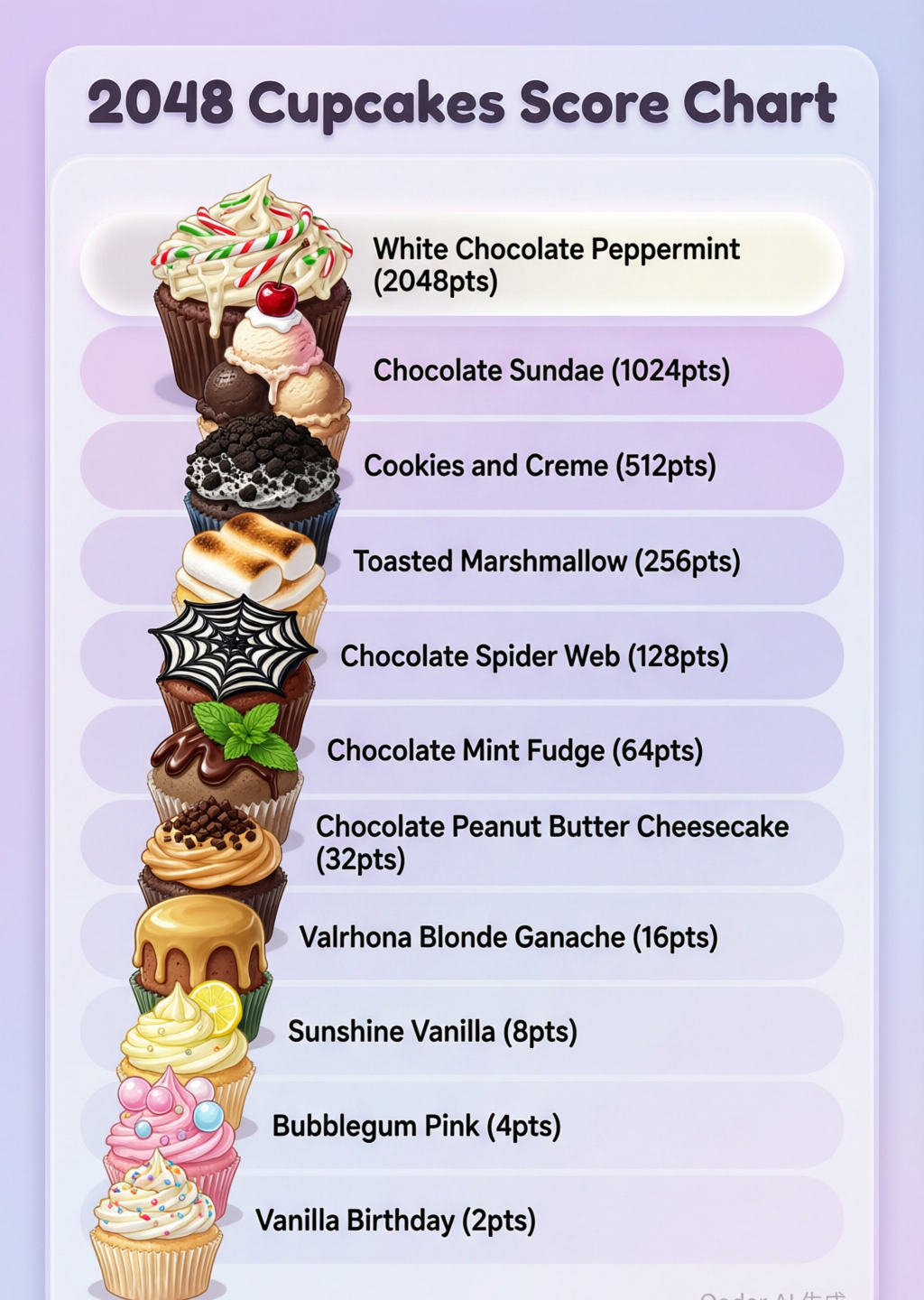
Notice the pattern: each tier is worth double the previous tier. This exponential growth means that higher-tier merges dominate your final score. A single White Chocolate Peppermint merge adds 2,048 points — more than all the lower-tier merges combined in many runs.
The Math Behind a 5,000-Point Run
Let’s break down what it takes to reach 5,000 points. If you create one White Chocolate Peppermint (2048), that single merge gives you 2,048 points. You still need 2,952 more points to hit 5,000. Those points come from all the other merges you made along the way.
1× White Chocolate Peppermint (2048) = 2,048 points
1× Chocolate Sundae (1024) = 1,024 points
2× Cookies and Creme (512) = 1,024 points
3× Toasted Marshmallow (256) = 768 points
Various lower-tier merges = ~136 points
Total: 5,000 points
The key takeaway: you don’t need to reach 2048 to score 5,000 points. A run with multiple high-tier merges (1024, 512, 256) can reach that target even if you never create the final 2048 tile. This is why focusing on efficient merging throughout the run matters more than obsessing over a single high tile.
Why Your Score Feels Lower Than Expected
If you’ve reached a Chocolate Sundae (1024) but your score is only around 2,500, you’re probably wondering what went wrong. The answer is usually one of three things:
1. You Made Wasted Merges
Every merge adds points, but some merges are more efficient than others. If you merged two Vanilla Birthday cupcakes (earning 2 points) when you could have waited and merged them into a higher-tier cupcake later, you missed an opportunity. The game doesn’t penalize you for small merges, but they don’t contribute much to your total.
2. You Didn’t Complete the Chain
To create a 1024 Chocolate Sundae, you need to build a complete chain: 2→4→8→16→32→64→128→256→512→1024. If you have gaps in that chain — say you created several 256 tiles but never merged them into 512 — you’re leaving points on the table. Each incomplete chain means you did the work but didn’t get the full score.
3. You Focused on the Wrong Tiles
Sometimes players chase a high tile in one corner while ignoring useful merges elsewhere. If you have two 512 tiles on the board but you’re busy trying to build a third 512 in a different area, you’re missing an easy 1,024-point merge. Always check whether completing a high-tier merge is possible before starting a new chain.
How to Maximize Your Score: 4 Proven Strategies
Strategy 1: Complete Every Chain You Start
If you’ve built a 256 tile, make it a priority to merge it into 512 rather than starting a new chain elsewhere. Each step up the chain doubles the merge value, so completing chains is the most efficient way to score. A run with three 512 merges (1,536 points total) will score higher than a run with one 1024 tile but several incomplete chains.
Strategy 2: Use the Corner Anchor Method
Keep your highest tile in one corner and arrange the next-highest tiles nearby. This makes it easier to see which merges are available and prevents you from accidentally separating tiles you need to combine. The corner strategy guide explains this in detail, but the scoring benefit is clear: you make more efficient merges when your tiles are organized.
Strategy 3: Avoid Merging Just Because You Can
Before you merge two matching cupcakes, check whether that merge helps or hurts your position. If merging two 64 tiles creates a 128 tile in a bad spot (blocking your corner or separating other pairs), it might be better to wait. A merge that improves your board layout is worth more in the long run than a merge that just adds a few points now.
Strategy 4: Track Your Progress
After each run, note your final score and the highest tile you reached. If you reached 1024 but scored only 2,500, you know you have incomplete chains or wasted merges. If you reached 512 but scored 3,000, you probably made efficient merges throughout. Over time, you’ll learn which habits lead to higher scores.
Common Scoring Mistakes (And How to Fix Them)
Mistake #1: Only caring about the highest tile. Reaching 2048 is impressive, but your score depends on all your merges, not just the final tile. A run with multiple 1024 and 512 merges can outscore a run that reaches 2048 but has fewer intermediate merges.
Mistake #2: Merging too quickly. Just because two cupcakes match doesn’t mean you should merge them immediately. If the merge creates a tile in a bad position or separates other pairs, wait for a better opportunity. Patience leads to higher scores.
Mistake #3: Ignoring the small merges. Every merge adds points, so don’t ignore the lower-tier cupcakes. A run with lots of efficient 2, 4, 8, and 16 merges will score higher than a run with the same high tile but fewer total merges.
Mistake #4: Not planning ahead. Before you merge, think about what tile you’ll create and where it will land. If you can predict that a merge will set up a higher-value merge in two or three moves, that’s a good merge to make. If it blocks your progress, skip it.
What’s a Good Score in 2048 Cupcakes?
Here’s a rough guide to help you gauge your progress:
- 1,000–2,000 points: You’re making merges but probably not completing chains efficiently. Focus on building complete sequences and avoiding wasted merges.
- 2,000–4,000 points: You’re reaching mid-tier cupcakes (256, 512) and making some efficient merges. Work on completing more chains and using the corner strategy.
- 4,000–6,000 points: You’re consistently reaching 1024 or higher and making purposeful merges throughout the run. This is solid play.
- 6,000+ points: You’re reaching 2048 or making multiple high-tier merges efficiently. This is advanced play.
Remember, these are guidelines, not hard rules. Your score depends on your merge efficiency, not just the highest tile you reach. A well-played run with a 1024 high tile can outscore a sloppy run with a 2048 high tile.
Frequently Asked Questions
Does reaching 2048 guarantee a high score?
No. Your score is the sum of all merge values, so a run with multiple high-tier merges can outscore a run that reaches 2048 but has fewer intermediate merges. Focus on completing chains and making efficient merges throughout the run, not just on reaching the 2048 tile.
Why did my score barely increase after a big merge?
If you merged two 512 tiles into 1024 but your score only increased by 1,024 points, that’s correct — that’s exactly what that merge is worth. If you expected a bigger jump, you might be thinking that the score is based on your highest tile value, but it’s actually based on the sum of all merge values. Every merge contributes to your total.
Is it better to make lots of small merges or a few big merges?
Both contribute to your score, but big merges are worth exponentially more. A single 1024 merge is worth 1,024 points, while you’d need 512 merges of 2-point cupcakes to equal that. However, you need small merges to build up to the big ones, so don’t ignore them. The key is to complete chains efficiently so that your small merges lead to big merges.
How can I improve my score without reaching a higher tile?
Focus on completing more chains. If you’re reaching 512 but not merging those into 1024, work on building complete sequences. Also, avoid wasted merges — don’t merge two cupcakes just because they match if the merge doesn’t improve your board. Efficient merging leads to higher scores even with the same high tile.
Use This Knowledge in Your Next Run
I’m Colon, and my advice is to stop guessing how scoring works and start using it to your advantage. Now that you know each merge value, you can make smarter decisions about which merges to prioritize. Complete your chains, avoid wasted merges, and track your progress. You’ll see your scores climb as you make more purposeful decisions.
For more strategy tips, check out the 10 tips for high scores guide, or learn how long it takes to reach 2048. If you’re new to the game, start with the how to play guide.
Ready to test your scoring knowledge? Play 2048 Cupcakes now and see how high you can score.